
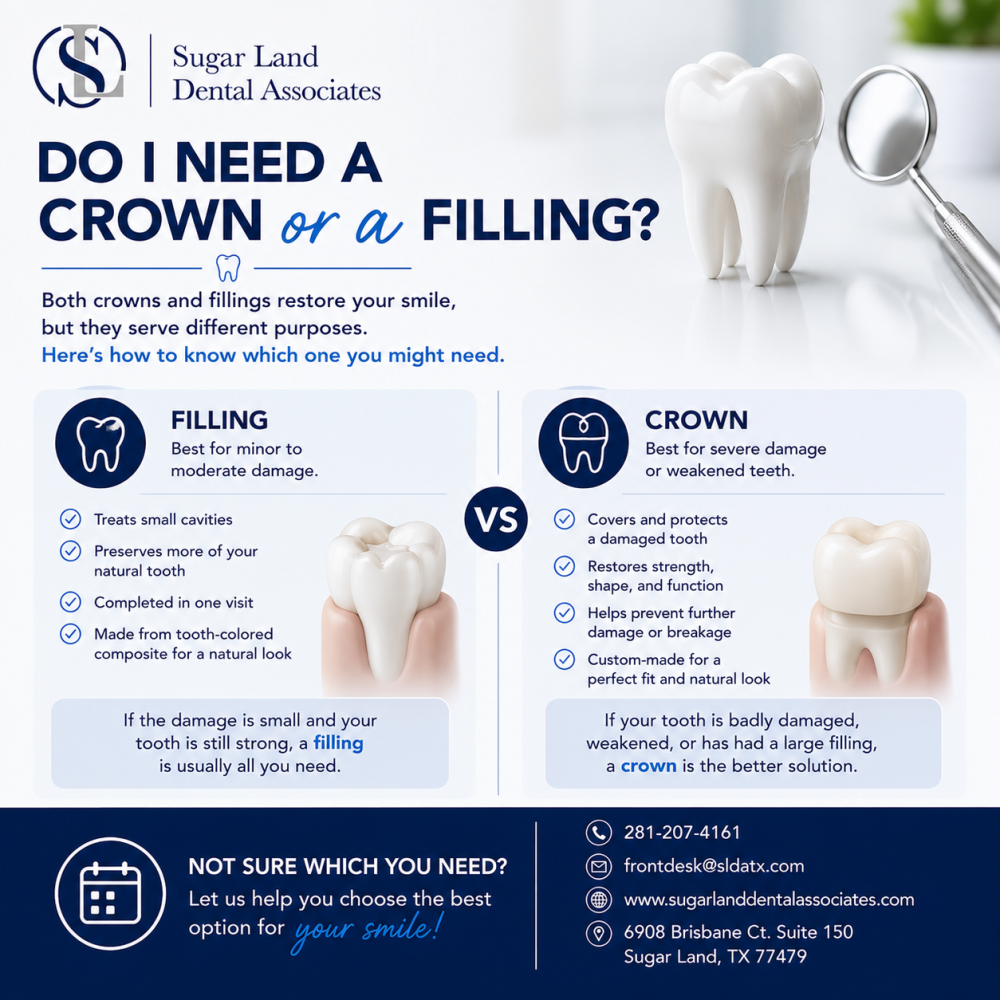
If you’ve ever been told you have a cavity, you may have wondered why one person gets a simple filling while another needs a crown. It’s one of the most common questions we hear at Sugar Land Dental Associates.
Both crowns and fillings repair damaged teeth, but they serve different purposes. Choosing the right treatment helps protect your tooth and prevent future problems.
What Is a Dental Filling?
A filling is used when a cavity or small area of damage can be repaired while preserving most of the natural tooth. After removing decay, the tooth is restored with a durable filling material that strengthens the area and restores normal function.
Fillings are typically recommended for:
Did You Know?
Treating a small cavity with a filling is often less invasive and less expensive than waiting until the damage becomes large enough to require a crown.
What Is a Dental Crown?
A dental crown is a personalized restoration designed to fit over the visible part of a tooth. It is often used when a tooth is too weakened, damaged or worn down to be reliably repaired with a standard filling.
A crown may be recommended if you have:
- A large cavity
- A cracked or weakened tooth
- A tooth after root canal treatment
- A severely worn or broken tooth
Crowns protect the remaining tooth and restore strength for chewing.
How Does Your Dentist Decide?
At Sugar Land Dental Associates, Dr. Rahil Patel carefully evaluates the size of the cavity, the strength of the remaining tooth, your bite, and your long-term oral health. The goal is always to preserve as much natural tooth as possible while providing a restoration that will last.
Myth vs. Fact
Myth: A crown is always better than a filling.
Fact: If a tooth can be predictably restored with a filling, preserving more natural tooth is usually the preferred approach.
Myth: Crowns last forever.
Fact: With good care, crowns can last many years, but they may eventually need replacement.
From Dr. Rahil Patel
“I always explain treatment options as if I were talking to a family member. Whenever possible, I prefer to preserve healthy tooth structure. The right restoration is the one that gives your tooth the best chance for long-term success.”
Quick Takeaways
- Fillings repair smaller areas of damage.
- Crowns protect teeth with significant damage.
- Early treatment can often prevent the need for a crown.
- Regular exams help detect cavities before they become larger.
Call to Action
If you’ve been told you need dental treatment or have questions about your options, schedule a consultation with Dr. Rahil Patel at Sugar Land Dental Associates. We’ll explain your choices and help you make an informed decision with no pressure.
FAQs
How do I know if I need a crown or a filling?
It depends on the amount of healthy tooth remaining. Small cavities are usually treated with fillings, while larger areas of damage often require crowns.
Can a filling become a crown later?
Yes. If decay or fractures progress, a tooth that once had a filling may later need a crown.
Does getting a crown hurt?
The procedure is performed with local anesthesia, and most patients are comfortable throughout treatment.
How long do crowns and fillings last?
With proper care, both can last for many years, although longevity depends on oral hygiene, bite forces, and routine dental care.